

Date:
October 28, 2026sh Academy of Sciences
Summary:
NASA’s Artemis I mission has revealed that cosmic radiation near the Moon is higher than in Earth orbit, but not by as much as scientists might expect. Tiny experimental detectors also uncovered surprising details about how radiation passes through the human body, offering valuable insights for future lunar exploration.
Share:
FULL STORY
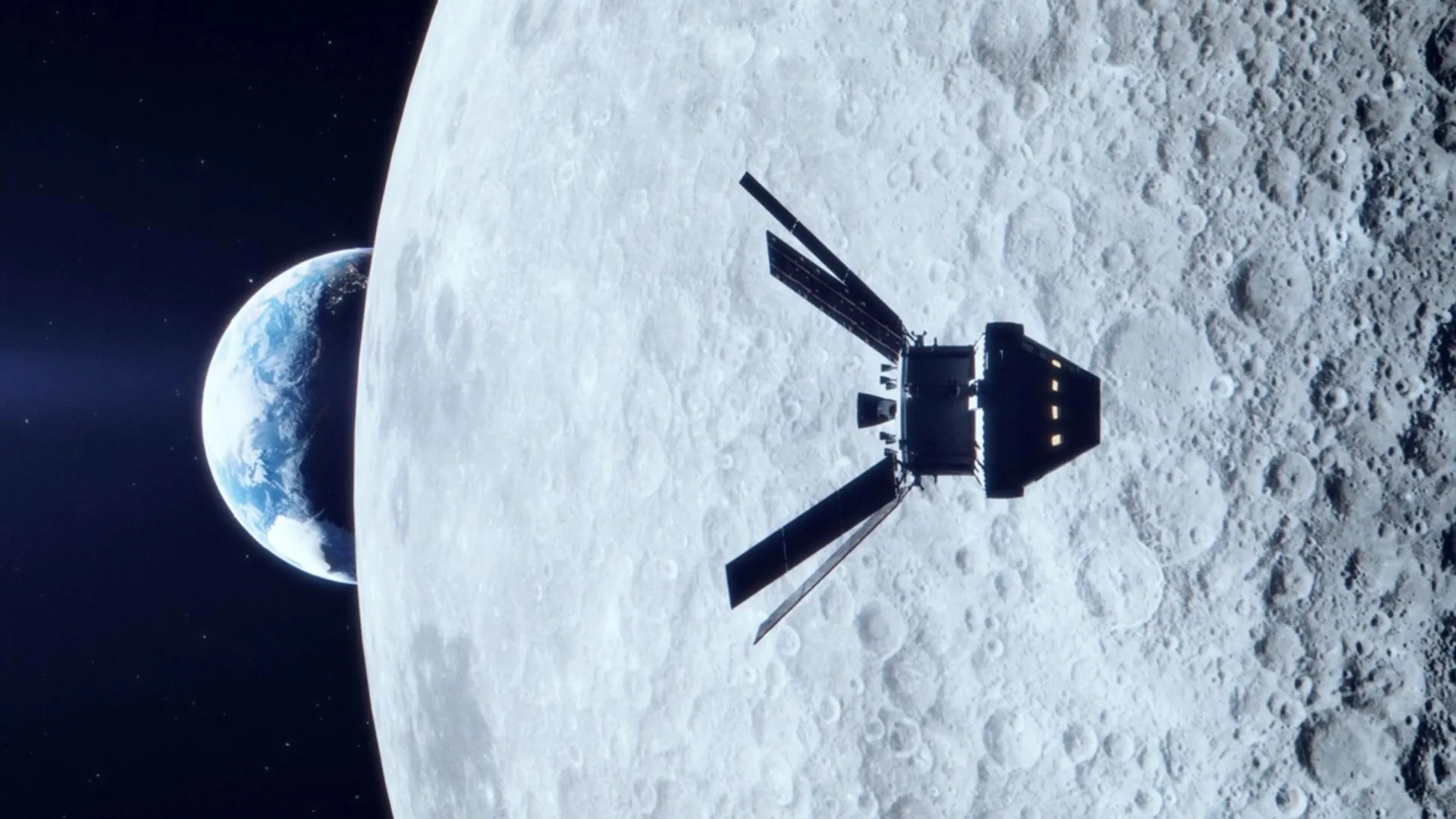
NASA’s Artemis I mission has provided new insights into how much cosmic radiation astronauts may encounter near the Moon compared with low Earth orbit. Using experimental detectors made from lithium fluoride crystals aboard the Orion spacecraft, researchers have obtained preliminary measurements that reveal unexpected differences in radiation exposure between the two environments.
During the uncrewed Artemis I mission in late November and early December 2022, Orion traveled around the Moon carrying more than 10,000 tiny crystals embedded inside two human-shaped mannequins. These devices recorded radiation exposure throughout the journey. Among them were several dozen experimental fluorescent lithium fluoride detectors created by scientists at the Institute of Nuclear Physics of the Polish Academy of Sciences (IFJ PAN) in Cracow. The researchers have now described a new method for analyzing the information stored in these crystals, offering insights into both cosmic radiation levels and the performance of the detectors. Their findings were published in the journal Radiation Measurements.
The fluorescent radiation dose detectors based on lithium
“The fluorescent radiation dose detectors based on lithium fluoride, developed at our institute, are passive in nature. In other words, they work like photographic film: once the crystals have been exposed to radiation, the tracks left by individual particles must be analyzed optically under a microscope,” explains Prof. Pawel Bilski (IFJ PAN), one of the co-authors of the paper.
How Tiny Crystals Detect Cosmic Radiation
The lithium fluoride detectors work by capturing microscopic changes caused by radiation. When electrically charged particles pass through a crystal, they disrupt its internal atomic structure, creating defects known as color centers. Scientists can later illuminate the crystal with blue light, causing these altered regions to glow red. By examining that fluorescence under a microscope, researchers can identify the paths taken by individual radiation particles.
The detectors were part of the MARE (Matroshka AstroRad Radiation Experiment) study conducted during Artemis I. Several dozen experimental lithium fluoride detectors were placed inside both mannequins, including some containing high concentrations of the lithium-7 isotope. The contribution from IFJ PAN extended beyond these experimental devices. Its scientists also supplied nearly 600 thermoluminescent crystal detectors, which use a different technique to measure radiation exposure.
One major advantage of the new lithium fluoride
One major advantage of the new lithium fluoride detectors is that they simplify the process of examining radiation tracks. Traditional passive detectors made from plastic require chemical etching before scientists can study the marks left by incoming particles. Lithium fluoride crystals eliminate that step, allowing researchers to inspect the tracks directly with a standard fluorescence microscope.
As a result, observing the radiation tracks collected near the Moon was relatively straightforward. The more difficult task was determining exactly what those tracks revealed about radiation exposure. To obtain reliable numerical measurements, the team had to develop sophisticated calibration and analysis techniques.
Why Measuring Deep Space Radiation Is So Difficult
Unlike the controlled conditions of a laboratory, cosmic radiation is highly unpredictable. In a typical physics experiment, researchers can expose a detector to a beam containing a known type of particle with a specific energy and direction. In space, radiation arrives from every direction and includes many different particles and atomic nuclei traveling across an enormous range of energies.
This complexity makes the microscopic tracks difficult
This complexity makes the microscopic tracks difficult to interpret. Because incoming particles strike the crystals at different angles, their tracks extend in multiple directions. A microscope captures the section of each track within its focal plane (approximately one micrometer in size), but it also records a blurry glow from portions outside that narrow region. This additional light influences the measured fluorescence intensity, which scientists use to estimate how densely a particle ionizes the material.
Different particles also produce very different track patterns. Those that cause strong ionization leave continuous, sharply defined lines, while particles that produce weaker ionization may appear as scattered, disconnected dots. These differences further complicate the task of translating fluorescence measurements into meaningful radiation data.
To overcome these challenges, the researchers introduced several corrections and developed software capable of removing unwanted background signals. The improved analysis brought their measurements into close agreement with results from established detector technologies while also revealing radiation events that older devices could not detect.
After applying a series of corrections and developing
“After applying a series of corrections and developing software to appropriately remove the background interfering with the measurements, our results differed by no more than 15% from those obtained using conventional track detectors across the entire overlapping range of energy deposition values. Moreover, we also recorded numerous particle tracks corresponding to energy deposits below the detection threshold of the detectors used to date,” Prof. Bilski emphasizes.
Artemis I Reveals a Surprising Difference in Moon Radiation
The Artemis I measurements also allowed researchers to compare radiation exposure near the Moon with findings from an earlier experiment aboard the International Space Station.
More than a decade before Artemis I, the MATROSHKA experiment investigated radiation exposure using human-shaped mannequins on the space station. Some of the radiation recorded during that mission came from low-energy protons trapped within Earth’s Van Allen radiation belts. As these particles traveled into the mannequins, they deposited energy at different depths, producing an uneven distribution of radiation doses.
Conditions near the Moon are substantially different
Conditions near the Moon are substantially different. The Van Allen belts do not extend into the lunar environment, so the radiation encountered there contains a greater contribution from high-energy particles originating elsewhere in the galaxy.
These galactic particles carry enough energy to travel through the entire human body, releasing only a portion of their energy as they pass. Consequently, the Artemis I detectors recorded radiation doses that were distributed almost uniformly throughout the mannequins, unlike the uneven patterns observed in the earlier space station experiment.
The researchers also identified a finding that may seem counterintuitive. Although astronauts near the Moon are exposed to more radiation than those in low Earth orbit, the difference is not necessarily as dramatic as might be assumed.
Low-energy protons, trapped by our planet’s magnetic field
“Low-energy protons, trapped by our planet’s magnetic field within the Van Allen belts, can account for the majority of the radiation dose received by astronauts in low Earth orbit. In the vicinity of the Moon, this substantial contribution disappears. Our measurements from the MARE experiment indicate that, although total radiation doses near the Moon are higher than those in Earth orbit due to the considerable levels of galactic radiation, the difference is not as large as one might intuitively expect,” Prof. Bilski notes.
New Radiation Detectors Could Help Protect Future Astronauts
The fluorescent lithium fluoride detectors aboard Artemis I were manufactured using the Czochralski method, a technique for growing crystals. Scientists at IFJ PAN first developed the technology about a decade ago and have continued refining it ever since.
Their compact size is one of their most useful features. Measuring just a few millimeters rather than several centimeters (on the order of millimeters rather than centimeters), the detectors are small enough to be worn comfortably by people, making them practical for monitoring radiation exposure during space missions.
They also provide sharper images of particle tracks
They also provide sharper images of particle tracks than conventional plastic detectors that require chemical etching. This improved resolution allows scientists to distinguish individual tracks even when radiation doses are relatively high. In addition, the crystals can register a broad variety of particle types and energies, potentially providing a more complete picture of the radiation environment.
Another advantage is their ability to detect neutrons, particularly when the crystals are enriched with the lithium-6 isotope. When neutrons interact with lithium nuclei, they can trigger nuclear reactions that generate secondary charged particles. These particles leave detectable changes in the crystal, much like other forms of ionizing radiation.
Together, these capabilities make lithium fluoride detectors a promising tool for studying the complex radiation environment beyond Earth. The measurements from Artemis I offer a clearer picture of how cosmic radiation behaves near the Moon and demonstrate how compact detectors could help scientists evaluate radiation exposure during future missions.
The research conducted as part of the MARE
The research conducted as part of the MARE project was supported by a grant from the National Science Centre, Poland (NCN), under its OPUS program.
Materials provided by The Henryk Niewodniczanski Institute of Nuclear Physics Polish Academy of Sciences. Note: Content may be edited for style and length.
- P. Bilski, A. Kilian, M. Sankowska, T. Horwacik, T. Berger. Application of LiF fluorescent nuclear track detectors for measurements of cosmic radiation at the lunar orbit within the MARE experiment. Radiation Measurements, 2026; 198: 107806 DOI: 10.1016/j.radmeas.2026.107806
The Henryk Niewodniczanski Institute of Nuclear Physics Polish Academy of Sciences. “NASA’s Artemis I mission reveals surprising radiation levels near the Moon.” ScienceDaily. ScienceDaily, 28 October 2026. <www.sciencedaily.com/releases/2026/10/261027063659.htm>.
The Henryk Niewodniczanski Institute of Nuclear Physics Polish Academy of Sciences. (2026, October 28). NASA’s Artemis I mission reveals surprising radiation levels near the Moon. ScienceDaily. Retrieved October 28, 2026 from www.sciencedaily.com/releases/2026/10/261027063659.htm
The Henryk Niewodniczanski Institute of Nuclear Physics Polish Academy of Sciences. “NASA’s Artemis I mission reveals surprising radiation levels near the Moon.” ScienceDaily. www.sciencedaily.com/releases/2026/10/261027063659.htm (accessed October 28, 2026).
RELATED STORIES
