

Date:
October 22, 2026created a groundbreaking $10 optical sensor that delivers the precision of laboratory equipment in a device small enough for wearable technology. It identified foods, plastics, and medicines with 100% accuracy in tests and demonstrated the ability to monitor blood glucose, alcohol, and other health markers without invasive procedures.
Share:
FULL STORY
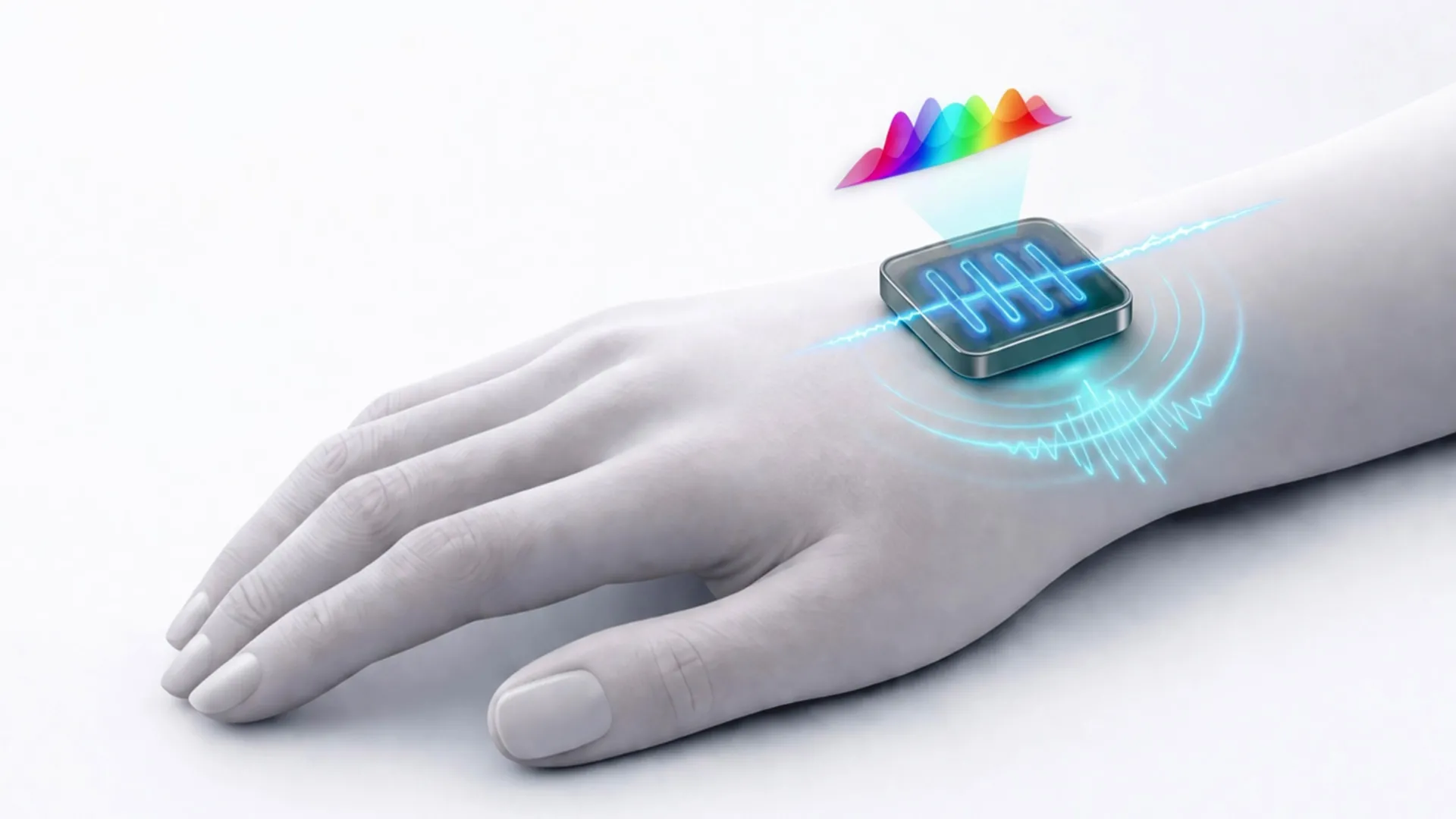
A new optical sensor costing just $10 could bring laboratory-level precision to wearable health monitors, potentially allowing people to track blood glucose without needles. The technology could also transform food testing, industrial quality control, and environmental monitoring.
Researchers at the University of Cambridge and GlitterinTech (a start-up founded by the same research group) have developed a new type of optical spectrometer that combines exceptional accuracy with a remarkably small size and low cost. Measuring just centimeters across, the device could be incorporated into portable electronics and wearable health technology. Its potential applications range from monitoring important health markers in real time to identifying materials and detecting changes in chemical composition.
Optical spectrometers work by analyzing light to reveal
Optical spectrometers work by analyzing light to reveal information about the substances it interacts with. They are essential tools in medicine, manufacturing, chemical testing, and environmental research. However, making these instruments smaller has traditionally meant compromising their performance. Compact spectrometers often have limited measurement ranges, reduced resolution, or lower accuracy, making them better suited to identifying substances than performing precise measurements.
The researchers believe their new design could overcome these limitations. Known as a convolutional spectrometer, it uses a mathematical principle called the convolution theorem to analyze light in a fundamentally different way. According to the team, this approach delivers performance that surpasses existing types of spectrometers in several key areas, including designs based on light dispersion, Fourier transforms, and computational reconstruction.
A New Way to Analyze Light With Extraordinary Precision
Traditional spectrometers generally separate incoming light into its component wavelengths or use complex calculations to reconstruct its spectrum. The new device takes another approach by performing a mathematical operation called convolution directly on the incoming light.
To accomplish this, the researchers arranged optical components
To accomplish this, the researchers arranged optical components with repeating spectral responses in a sequence. These components can include unbalanced Mach-Zehnder interferometers or micro-ring resonators. By adjusting them in proportion to one another, the system can shift its response to different wavelengths in a controlled, linear fashion. Fast Fourier transforms are then used to accurately recover the light spectrum.
“The key insight was to go back to the mathematics and ask whether there was a fundamentally cleaner way to retrieve spectra,” said Dr. Chunhui Yao, a lead author of the study. “By using the convolution theorem directly in the optical domain, we avoid many of the limitations that have held miniaturized spectrometers back. This gives us high precision, strong noise tolerance, and very low computational overhead, all in a compact and low-cost system.”
The researchers built the spectrometer using a silicon nitride photonic platform and integrated it with onboard electronics. It operates across a broad range of near-infrared wavelengths (1200-1700 nm) and can collect and process measurements in less than a second.
Another important advantage is its ability to expand
Another important advantage is its ability to expand its measurement capabilities without major hardware changes. Because the system uses repeating optical patterns, its spectral bandwidth can theoretically be extended almost without limit. Adding more optical components in sequence can also increase its resolution exponentially.
A $10 Sensor That Could Transform Food Testing and Healthcare
To evaluate the device outside purely theoretical measurements, the researchers tested it on a variety of materials and substances. The results demonstrated its potential for applications that normally depend on larger, more expensive laboratory instruments.
When used to identify plastics, pharmaceuticals, coffee, flour, and tea, the spectrometer achieved a 100% classification success rate in the reported tests. It also measured concentrations in water-based and organic solutions with accuracies of approximately 0.01%, exceeding the performance of commercial benchtop spectrometers in those experiments.
The healthcare demonstrations were particularly promising
The healthcare demonstrations were particularly promising. Under conditions designed to reflect real physiological environments, the device accurately measured several human biomarkers, including skin moisture, blood alcohol, blood lactate, and blood glucose.
The researchers also demonstrated noninvasive glucose tracking over an extended period in one participant. Although further testing would be needed before the technology could become a practical medical product, the finding suggests a possible route toward monitoring blood sugar without repeatedly piercing the skin.
“These biomedical demonstrations are particularly exciting,” said Prof. Qixiang Cheng, who led the project. “What makes this work stand out is not just performance in the lab, but technical readiness. Dr. Chunhui Yao’s contribution was crucial in translating a mathematical concept into a fully packaged, robust system that operates reliably across temperature extremes and real-world conditions. That combination is what opens the door to practical deployment.”
The sensor also demonstrated impressive resistance to temperature
The sensor also demonstrated impressive resistance to temperature changes. It continued operating reliably between -20°C and 80°C, an unusually wide temperature range for a miniature spectrometer. This durability could be especially valuable for wearable devices, factory equipment, and sensors operating outdoors.
Why a Simpler Design Could Be a Major Breakthrough
The new spectrometer’s advantages extend beyond its accuracy, size, and price. Its internal design also reduces the amount of computing power needed to analyze incoming light.
Many existing miniature spectrometers depend on complicated calibration procedures and demanding algorithms to reconstruct spectral information. These methods can become unreliable when measurements contain noise, and they often require substantial processing re
The Cambridge team’s convolution-based approach avoids much
The Cambridge team’s convolution-based approach avoids much of this complexity. Because the measurements follow a linear mathematical relationship, the system can recover spectra rapidly and consistently while using relatively little computational power.
“This is a beautiful example of how elegant engineering can unlock real impact,” said Prof. Richard Penty, who contributed to the photonic system design and integration. “The architecture is simple, scalable, and manufacturable, yet it delivers precision that rivals or exceeds much larger instruments. Dr. Chunhui Yao played a central role in bringing together the photonic design, system integration, and experimental validation that made this possible.”
Its relatively simple construction could also make the technology easier to manufacture on a large scale, potentially bringing sophisticated optical measurements to devices where conventional spectrometers would be too bulky or expensive.
Bringing Laboratory-Grade Measurements to Everyday Devices
The researchers envision a future in which accurate
The researchers envision a future in which accurate optical sensing becomes a routine feature of everyday technology rather than something largely confined to specialized laboratories.
In industrial settings, inexpensive spectrometers could be installed throughout manufacturing facilities to continuously check material composition and product quality. Similar sensors could monitor food freshness, identify substances, and analyze environmental conditions on a much larger scale than is currently practical.
Healthcare could see equally significant changes. Compact sensors might eventually enable wearables to measure hydration levels, detect signs of alcohol intoxication, track biomarkers related to physical fitness, or continuously monitor glucose levels for people managing diabetes.
Our vision is to make spectrometry as ubiquitous
“Our vision is to make spectrometry as ubiquitous as temperature or motion sensing,” added Prof. Qixiang Cheng. “This work shows that high-quality spectral information doesn’t have to be confined to the laboratory — it can be embedded directly into the technologies people use every day.”
As photonic technology becomes smaller and more advanced, the convolutional spectrometer provides a promising example of how mathematical insights and practical engineering can make sophisticated scientific instruments simpler, cheaper, and more accessible. By combining high precision with a device that costs around $10, the researchers have opened a potential path toward a new generation of smart sensors capable of measuring the hidden chemistry of our bodies and surroundings.
Materials provided by University of Cambridge. Original Note: Content may be edited for style and length
- Chunhui Yao, Jie Ma, Ningning Wang, Peng Bao, Wei Zhuo, Tao Zhang, Wanlu Zhang, Kangning Xu, Ting Yan, Liang Ming, Yuxiao Ye, Tawfique Hasan, Ian White, Richard Penty, Qixiang Cheng. Optical convolutional spectrometer. Nature Photonics, 2026; 20 (6): 664 DOI: 10.1038/s41566-026-01891-6
University of Cambridge. “Cambridge scientists create a $10 chip that could put a medical lab on your wrist.” ScienceDaily. ScienceDaily, 22 October 2026. <www.sciencedaily.com/releases/2026/10/261022081312.htm>.
University of Cambridge. (2026, October 22). Cambridge scientists create a $10 chip that could put a medical lab on your wrist. ScienceDaily. Retrieved October 22, 2026 from www.sciencedaily.com/releases/2026/10/261022081312.htm
University of Cambridge. “Cambridge scientists create a $10 chip that could put a medical lab on your wrist.” ScienceDaily. www.sciencedaily.com/releases/2026/10/261022081312.htm (accessed October 22, 2026).
RELATED STORIES
