

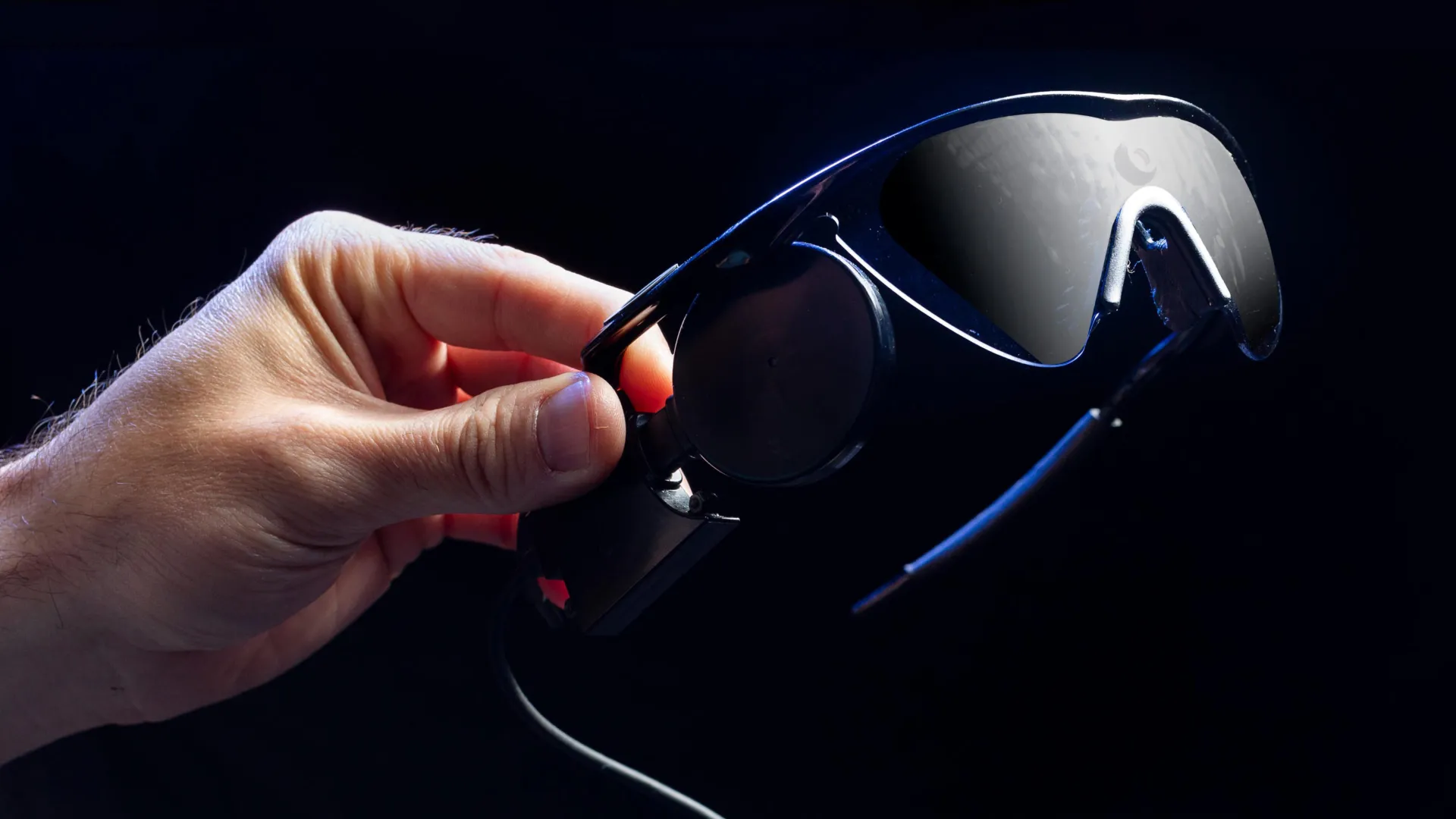
powered bionic eye breakthrough could help the blind see again
Using AI to make bionic vision smarter and more precise, scientists are bringing the possibility of restoring sight to people with blindness one step closer to reality.
Date:
November 12, 2026 have developed an AI-powered approach that makes experimental bionic vision technology more precise, helping predict the flashes and shapes of light perceived by a blind man with a brain implant. By learning how an individual’s brain responds to electrical stimulation, the technology could bring researchers closer to restoring some degree of sight to people with blindness.
Share:
FULL STORY
Artificial intelligence could help overcome one of the biggest challenges in restoring vision to people who are blind: getting a brain implant to produce reliable visual experiences. Researchers from three institutions, including UC Santa Barbara, have demonstrated that AI can improve how precisely an experimental visual prosthesis stimulates the brain and predicts what a person perceives.
The team used a deep learning system to develop electrical stimulation patterns for electrodes temporarily implanted in the visual cortex, the region at the back of the brain responsible for processing visual information. By analyzing the brain’s responses, the technology gave researchers greater control over neural activity and helped them better anticipate the visual sensations produced by the implant.
Published online in the journal Neuron, the proof-of-concept study represents progress toward more advanced visual prostheses, sometimes described as bionic eyes. These devices could eventually become more effective by learning how each person’s brain responds to stimulation rather than relying on predetermined settings.
“Building a model in the abstract is one thing,” said Michael Beyeler, an associate professor of computer science and psychological and brain sciences at UC Santa Barbara. “Seeing it shape an experiment with a person is something else entirely. That ability to go from theory to something that may one day help people is what drives much of the work in our lab.”
How Bionic Vision Could Bypass Damaged Eyes
For decades, scientists have worked to develop technologies capable of restoring some vision to people who are blind, although the results have generally been limited. Some experimental devices stimulate the retina, the layer of tissue at the back of the eye that detects light. Others attempt to activate parts of the visual system farther along the pathway that carries visual information to the brain.
Visual cortical prostheses work differently. Instead of depending on the eyes or optic nerves, they deliver electrical signals directly to the visual cortex. This approach could offer a potential solution for people whose visual pathways have been damaged but whose visual cortex can still respond to stimulation. Possible candidates include individuals who lost their sight because of strokes, neurodegenerative diseases, or traumatic brain injuries.
The ability to regain even limited vision could be especially meaningful for people who remember what it was like to see.
Beyeler highlighted those “who have been able to see for part of their life, but then, because of an inherited eye disease or an accident, have lost their vision,” adding, “For those people, the desire may be very strong to get some vision back.”
The new findings build on earlier computational researchsupported by Beyeler’s 2022 National Institutes of Health (NIH) Director’s New Innovator Award. The five-year, $2 million grant has supported his efforts to make artificial vision systems more accurate, predictable, and effective.
Scientists Test AI With a Brain Implant in a Blind Man
An important opportunity to test the technology came in 2024, when researchers from Beyeler’s Bionic Vision Lab traveled to Spain. Their goal was to determine whether their computer models could improve the performance of a brain implant already being used in an experimental study.
At Hospital IMED Elche, the team worked with a 27-year-old man who had become blind following a traumatic brain injury. He had received an implant containing 96 electrodes arranged in an array within his visual cortex. The device was intended to remain in place for six months before being removed.
When researchers activated the electrodes using electrical current, the participant experienced visual sensations known as phosphenes. These can appear as spots, flashes, or shapes of light, sometimes resembling stars or fireworks.
Producing these sensations is possible, but making them consistent and predictable is much more difficult. The same electrical stimulation does not always trigger an identical response, and activating particular electrodes does not guarantee that the person will perceive a specific visual pattern.
To address this problem, the researchers trained a deep neural network, a type of AI designed to recognize complex patterns, to predict how the visual cortex would respond to different electrical stimulation settings. The model also considered the brain’s resting activity immediately before stimulation, giving it information about the participant’s current neural state.
Using these predictions, the researchers identified combinations of electrical signals that were most likely to produce particular patterns of brain activity.
AI Makes Bionic Vision More Precise
When the scientists tested the stimulation patterns selected by AI, the results were encouraging. The new approach generated the intended patterns of neural activity more accurately than the comparison methods while requiring less electrical current.
Another important discovery emerged when the team examined the relationship between brain activity and the participant’s visual experiences. The patterns recorded directly from his brain were better predictors of what he perceived than the stimulation settings themselves.
This distinction matters because activating the brain is not the same as knowing what a person will see. Even when researchers can produce a desired neural response, they still need to understand how the brain transforms that activity into a conscious visual experience.
“Engineers naturally want to treat phosphenes like pixels: stimulate more electrodes, and you should get a more complete image,” Beyeler said. “But the brain does not work that way. Electrodes interact, neural responses fluctuate, and what we put into the brain is not necessarily what the person perceives. The challenge is to learn more about that transformation.”
The findings suggest that future visual prostheses may need to do more than simply deliver electrical signals. They may also need to monitor how the brain reacts and use that feedback to continually improve stimulation.
Teaching Brain Implants to Adapt to Each Person
A key advantage of the implant used in the experiment was its ability to perform two tasks. It could stimulate the visual cortex with electrical current while simultaneously recording the resulting neural activity.
This allowed researchers to train their AI model using the brain’s actual responses rather than relying exclusively on information about which electrodes were activated and how much current they delivered.
The participant also provided feedback about what he experienced. He reported whether he saw a phosphene and, during certain experiments, described its appearance, including its shape, size, brightness, and color.
Comparing these reports with the recorded brain activity revealed that neural responses contained more useful information about the perceived visual sensations than the electrical stimulation parameters alone.
The AI system also used measurements of resting brain activity to account for changes in the participant’s neural state before each stimulation. This could be particularly valuable because the brain’s response to electrical signals can vary over time, including from one day to the next.
“A useful visual prosthesis cannot rely on a fixed recipe,” Beyeler said. “It has to learn how an individual brain responds and adapt the stimulation accordingly. Ultimately, the device should adapt to the person, not the other way around.”
A Collaborative Step Toward Restoring Sight
The research brought together scientists from UC Santa Barbara, ETH Zurich, and Miguel Hernández University (MHU). Beyeler described the effort as “a true collaboration.”
The project was led by co-first authors Pehuén Moure of ETH Zurich, Jacob Granley of UC Santa Barbara, and Fabrizio Grani of MHU. The supervising researchers were Beyeler, Shih-Chii Liu of ETH Zurich, and Eduardo Fernández of MHU. Their work forms part of a larger feasibility trial taking place in Spain.
Although the technology remains experimental and the participant’s visual experiences were limited to flashes and shapes of light, the results demonstrate how AI could improve communication between artificial vision devices and the brain.
Rather than treating every brain as if it responds the same way, future bionic vision systems could learn from each individual and adjust their signals accordingly. That personalized approach may prove essential to developing implants that can eventually restore useful vision to people who have lost their sight.
Materials provided by University of California – Santa Barbara. Note: Content may be edited for style and length.
- Pehuén Moure, Jacob Granley, Fabrizio Grani, Leili Soo, Antonio Lozano, Rocío López-Peco, Adrián Villamarín-Ortiz, Cristina Soto-Sánchez, Shih-Chii Liu, Michael Beyeler, Eduardo Fernández. Deep learning-based control of electrically evoked activity in human visual cortex. Neuron, 2026; DOI: 10.1016/j.neuron.2026.07.006
University of California – Santa Barbara. “AI-powered bionic eye breakthrough could help the blind see again.” ScienceDaily. ScienceDaily, 12 November 2026. <www.sciencedaily.com/releases/2026/11/261110042553.htm>.
University of California – Santa Barbara. (2026, November 12). AI-powered bionic eye breakthrough could help the blind see again. ScienceDaily. Retrieved November 13, 2026 from www.sciencedaily.com/releases/2026/11/261110042553.htm
University of California – Santa Barbara. “AI-powered bionic eye breakthrough could help the blind see again.” ScienceDaily. www.sciencedaily.com/releases/2026/11/261110042553.htm (accessed November 13, 2026).
RELATED STORIES
