

For most of my life, I had a second full-time job. Nobody hired me for it. Nobody paid me. But it ate more hours than anything else I did. The job was pretending to be normal.
I am autistic. Growing up, I didn’t always have that word for it, but I knew one thing for sure: I was different, and different was not safe.
Kids let me know early. I got teased and picked on, and more than once someone looked at me like I was a science experiment and asked if I was from another planet.
I did what a lot of kids do
So I did what a lot of kids do. I decided the problem was me, and I got to work fixing it.
I studied other people the way you’d study for an exam. I watched how they stood in groups, when they laughed, how long they held eye contact before looking away.
I memorized jokes.
I practiced facial expressions in the mirror.
I learned the rules of conversation like they were traffic laws: ask questions, don’t interrupt, don’t talk too long about the thing you actually care about.
I got good at it. That’s the exhausting part
For years I could walk into a room
For years I could walk into a room and perform “normal” so convincingly that most people never suspected a thing. I made the small talk. I laughed at the right moments. I nodded along. And then I
went home and collapsed, completely spent, like I’d run a marathon I never signed up for.
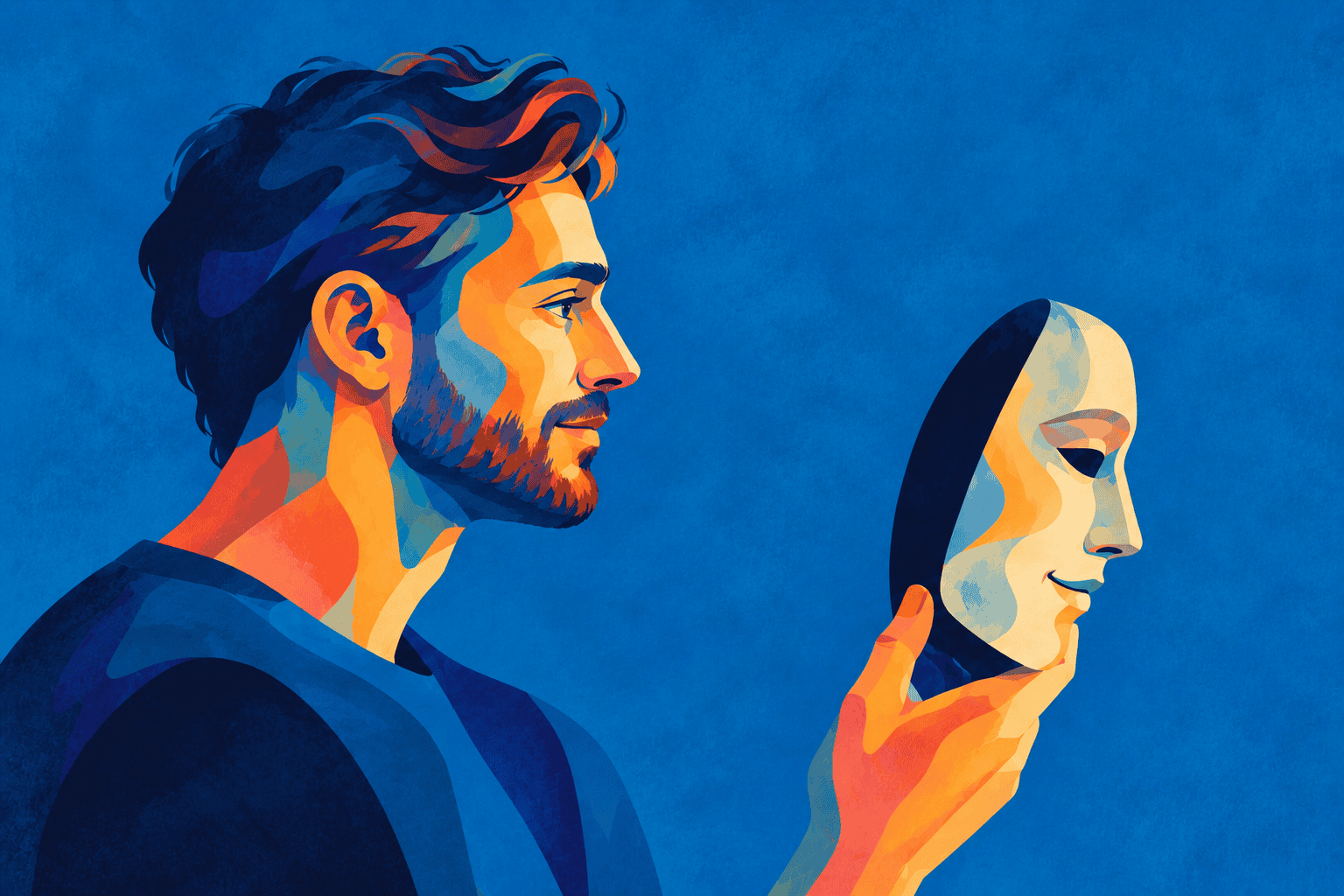
That’s what masking is, though I didn’t call it that at the time. It’s performing a version of yourself that’s acceptable to everyone else, at the cost of the person underneath.
Every social interaction became a performance. Every conversation, a tightrope walk. And I never got to put the costume down, because what if someone saw the real me and decided I wasn’t worth knowing?
The burnout crept up slowly
The burnout crept up slowly. It started as tiredness—bone-deep tiredness after ordinary days. Then it became something heavier. I started dreading things I used to enjoy. Phone calls sat unanswered.
Invitations piled up. I’d cancel plans not because I didn’t want to see people, but because the thought of performing for another three hours made me want to cry.
I told myself I was lazy. I told myself everyone felt this way, and I just needed to try harder. That last part is funny, because trying harder was the whole problem. I had been trying harder than anyone around me for years, and it was breaking me.
Here’s the thing nobody tells you about pretending
Here’s the thing nobody tells you about pretending to be someone else: it works just well enough to keep you trapped. I was functional. I held it together in public. So nobody saw a crisis. They saw a quiet
guy who was maybe a little tired. And because I looked fine, I believed I should be fine, and I kept pushing the real feelings down and the performance up.
The turning point didn’t arrive as some dramatic revelation. There was no lightning bolt. It was more like a slow leak—the realization that I could keep this up for the rest of my life and be miserable, or I could stop and find out what was on the other side.
Stopping looked small at first. I stopped forcing eye contact that felt like staring into the sun. I stopped laughing at jokes I didn’t find funny. I let myself stim—rocking a little, fidgeting with my hands—the stuff my body had always wanted to do, but I’d always been too ashamed to let it.
I stopped apologizing for needing quiet
I stopped apologizing for needing quiet. For years, I’d treated my need to recharge alone like a character flaw, something to confess. “Sorry, I’m just tired.” “Sorry, I need to head out early.” I dropped the sorry. I just needed quiet. That’s allowed.
And something strange happened. The world didn’t end.
Nobody staged an intervention because I stopped making small talk about the weather. A few friendships shifted—the ones built entirely on my performance couldn’t survive without it, and honestly, good riddance. But the real ones got better. It turns out people can feel it when you’re performing, and it’s actually harder to connect with someone wearing a mask than someone being awkwardly, genuinely themselves.
The biggest change was internal. For the first time, I wasn’t spending every waking hour monitoring myself.
Imagine carrying a heavy backpack everywhere for twenty
Imagine carrying a heavy backpack everywhere for twenty years and finally setting it down. That’s what dropping the mask felt like. My shoulders came down. My jaw unclenched. I had energy left at the end of the day—energy I couldspend on things I actually enjoyed instead of recovering from things I endured.
I started noticing what I actually liked, not what I thought I was supposed to like.
I stopped forcing myself into loud, crowded situations to prove I could handle them and started choosing the quiet coffee shop, the walk alone, the evening with one good friend instead of the party with thirty acquaintances.
My life got smaller in some ways and infinitely richer in others.
Accepting that I’m autistic didn’t fix everything
Accepting that I’m autistic didn’t fix everything. I still have hard days. Sensory overload is real—a bad fluorescent light or a chaotic room can still wreck me. But now when it happens, I don’t add a layer of shame on top of it. I don’t think, “What’s wrong with me?” I think, “This environment isn’t built for my brain, and that’s information, not a verdict.”
That shift—from “I’m broken” to “I’m different and that’s fine”—changed everything. Not because the world changed. It didn’t. But because I stopped asking the world for permission to be myself.
Here’s what I want you to know, if you’re reading this and you’re exhausted from your own version of the performance: the mask feels like protection, but it’s actually a cage. It keeps you safe from rejection, sure. But it also keeps you from rest, from genuine connection, from the relief of just being a person instead of a project.
You don’t have to drop it all
You don’t have to drop it all at once. I didn’t. Start small. Let one unguarded thing be true in one safe place. Notice how it feels. Notice that the people worth keeping don’t flinch.
I spent years trying to be normal, and all it got me was tired. Theday I stopped, I didn’t become someone new. I became someone I’d been all along, underneath the performance—and he turned out to be worth knowing. Normal was never the goal. It was the obstacle. And I don’t miss it at all.
About Jimmy Clare
Jimmy Clare is an autistic writer and speaker (Speaker of the Year 2026) who shares stories about self-acceptance, belonging, and life on the spectrum. He’s the founder of CrazyFitnessGuy and host of The CrazyFitnessGuy Show. https://jimmyclarespeaks.com
- Web
- More Posts
|
See a typo or inaccuracy? Please contact us so we can fix it!
