

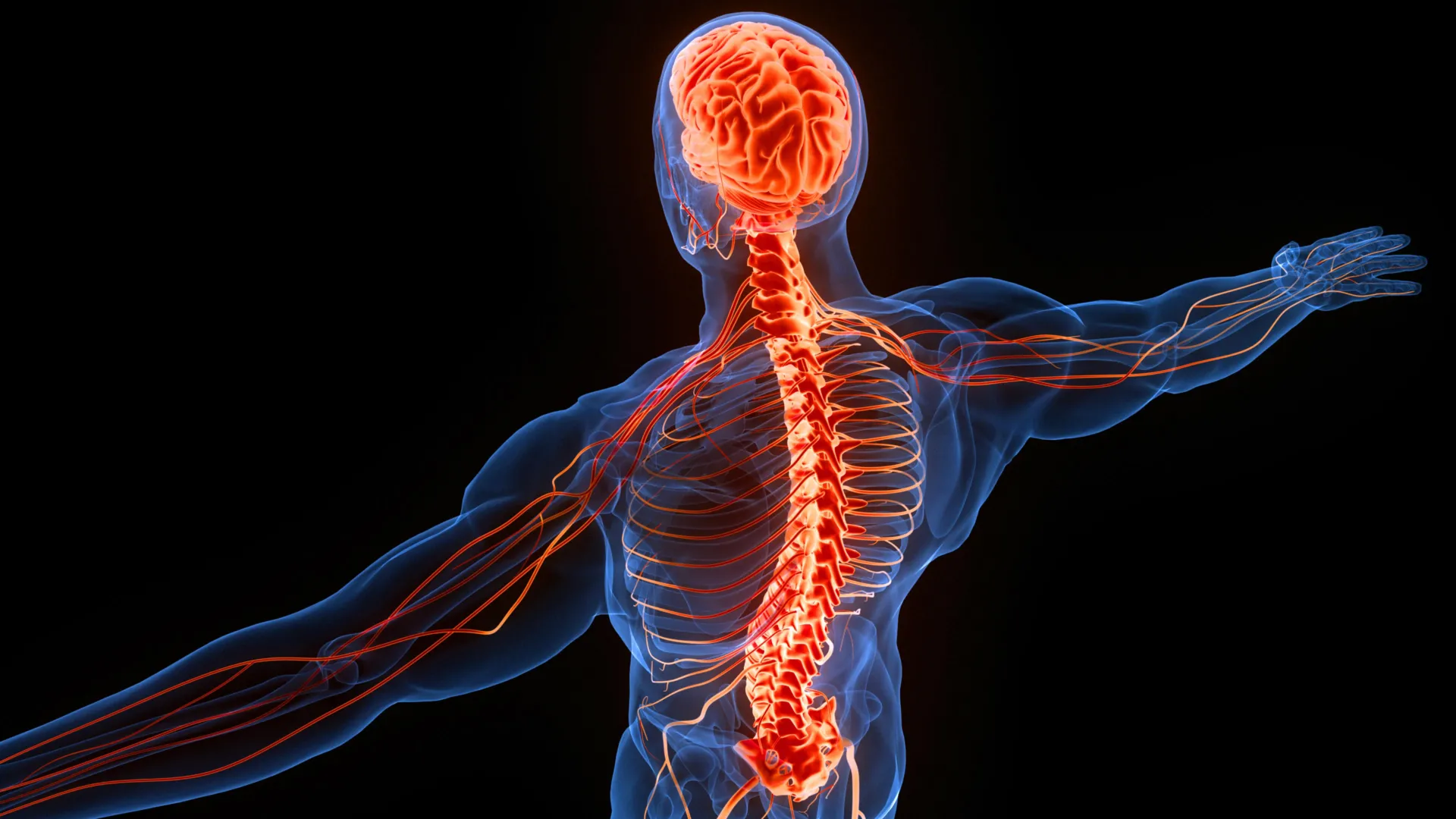
Scientists may have finally explained why our brains and bodies are cross-wired
Date:
November 4, 2026rious cross-wiring, which connects each hemisphere to the opposite side of the body, may have originated more than 500 million years ago in the visual systems of ancient fish. Rather than evolving for a specific advantage, this unusual arrangement may simply be a legacy of evolution building new brain circuits on an ancient foundation.
Share:
FULL STORY
Why does the left side of the brain control the right side of the body, while the right side controls the left? This unusual arrangement is one of the most intriguing features of the nervous system, and scientists have proposed a new explanation that reaches back hundreds of millions of years.
Dr. Martin Wessendorf, a neuroscientist and associate professor emeritus at the University of Minnesota, studies how the brainstem regulates neurons in the spinal cord. Daniel Wang specializes in cognitive neuroscience and neurodegenerative diseases. Together, they have examined the evolutionary origins of the brain’s crossed connections.
In a study published in Frontiers in Neuroanatomy,
In a study published in Frontiers in Neuroanatomy, the researchers explore several neural circuits in four-limbed animals that are cross-wired (meaning one side of the brain connects with the opposite side of the body). Their hypothesis suggests that these connections may have developed because evolution built new brain circuits around an ancient visual system.
The brain contains numerous pathways that cross from one side of the central nervous system to the other. Understanding why these contralateral (midline-crossing) connections exist requires examining how different sensory and movement circuits developed over evolutionary time.
How the Brain Processes Visual Information
One possible explanation begins with the eyes. When light passes through the eye’s lens, the image projected onto the retina is reversed. Objects appearing to our right are projected onto the left side of the retina, while objects on our left are projected onto the right.
Visual information travels along the optic nerve
Visual information travels along the optic nerve to a structure called the optic chiasm. Here, nerve fibers are organized so that information from the right visual field reaches the left side of the brain, while information from the left visual field is directed to the right side.
Some of these signals reach an ancient brain structure called the optic tectum (which in mammals is called the superior colliculus). Located in the midbrain, this region helps produce fast reactions to visual events, such as suddenly noticing something moving nearby.
Each side of the optic tectum contains a representation of the opposite visual field. Deeper within the structure, information about physical sensations (somatosensory information) is also organized into corresponding maps.
Because the optic tectum exists in every vertebrate
Because the optic tectum exists in every vertebrate species, it is considered one of the most ancient structures in the vertebrate nervous system. Its early appearance may be especially important for understanding why so many other neural pathways cross sides.
Why Sensory Signals Cross the Brain and Spinal Cord
The researchers also examined two major pathways responsible for transmitting sensations from the body to the brain. Both cross the center of the central nervous system (the brain and spinal cord), and both appear to be widespread among tetrapods (the animals with four limbs, including mammals, birds, reptiles, and amphibians).
The first, called the dorsal column pathway, carries information about gentle touch, vibration, and the position of different body parts. Signals from the limbs and torso travel upward through the dorsal portion of the spinal cord before reaching another neuron in the brainstem, just above the spinal cord. From there, the pathway crosses to the opposite side.
Although fish lack this pathway, scientists have identified
Although fish lack this pathway, scientists have identified it in amphibians, reptiles, birds, and mammals. Its presence across these major animal groups suggests that the arrangement emerged early in tetrapod evolution and has remained largely conserved.
The second pathway, known as the spinothalamic tract, transmits sensations involving pain, itching, and certain types of touch. Unlike the dorsal column pathway, it crosses to the opposite side within the spinal cord itself.
After crossing, signals travel upward to the thalamus, a brain region located above the midbrain that plays a central role in processing sensory and movement information.
This crossed arrangement is found in birds, mammals,
This crossed arrangement is found in birds, mammals, and reptiles. It also occurs in some cartilaginous fish, including sharks and rays, suggesting that aspects of this organization have even deeper evolutionary roots.
How the Brain Controls Movement Across the Body
The crossed organization of the nervous system extends beyond sensation. The researchers identified three important pathways involved in controlling skeletal muscles that also connect one side of the brain with the opposite side of the spinal cord.
The first is the tectospinal pathway, which helps the body respond rapidly to information from the environment.
The optic tectum processes more than vision
The optic tectum processes more than vision. It also receives information about sounds and physical sensations, organizing these signals into maps that align with its visual representation on the opposite side of the brain.
Imagine preparing to cross a street when you suddenly notice a car approaching from the corner of your eye. You instinctively turn toward the vehicle. The tectospinal pathway is one of the neural circuits that helps produce this rapid response. It can also coordinate similar reactions to unexpected sounds or touch.
The movement signals originate in the deepest layers of the optic tectum and travel through nerve fibers to the opposite side of the spinal cord. This pathway is present in most tetrapods and certain cartilaginous fish.
Another important circuit is the rubrospinal pathway, which
Another important circuit is the rubrospinal pathway, which is thought to help animals control their limbs. It begins in a midbrain structure called the red nucleus and extends to the opposite side of the spinal cord. The pathway is especially prominent in most mammals, although it has also been identified in other tetrapods and some cartilaginous fish.
The Evolution of Fine Motor Control in Humans
The third pathway, called the corticospinal tract, has a particularly important role in humans because it supports precise movements, including the fine control of our fingers.
Its evolutionary history is more complicated than that of the other pathways.
All vertebrates possess a telencephalon, the forward portion of the brain that accounts for much of the brain’s overall size in humans. However, only mammals have a cerebral cortex organized into six distinct layers.
This six-layered cortex supports sophisticated functions such
This six-layered cortex supports sophisticated functions such as combining sensory information with memories, coordinating movement, and processing language.
The corticospinal pathway extends from the cerebral cortex toward the spinal cord, but its function varies among animals.
In most mammals, it primarily influences sensory processing. Nerve fibers reach spinal cord regions that receive information from the body, allowing the brain to regulate incoming sensations.
In primates (including humans) and certain other animals
In primates (including humans) and certain other animals capable of highly precise movements, the pathway also reaches spinal cord regions responsible for controlling muscles. These connections make intricate actions possible, including the coordinated finger movements needed for delicate tasks.
Depending on the species, the corticospinal tract can regulate sensory information or contribute directly to movement. In either case, its fibers cross the midline of the nervous system.
The researchers suggest that humans may have developed advanced fine motor abilities by adapting an older neural circuit originally involved in controlling sensory input. Rather than creating an entirely new system, evolution may have given an existing pathway an additional purpose.
A 500-Million-Year-Old Explanation for the Brain’s Crossed Wiring
Taken together, these neural pathways point toward
Taken together, these neural pathways point toward a potentially surprising explanation for the brain’s unusual organization.
The researchers propose that the earliest visual circuits helped establish a pattern in which sensory and movement pathways were organized across opposite sides of the nervous system. Later circuits may have inherited this arrangement as they evolved, particularly in tetrapods.
Because every living vertebrate possesses an optic chiasm and an optic tectum organized around information from the opposite visual field, the researchers suspect that these structures were already present in primitive jawless fish during the Cambrian Period, approximately 538 to 486 million years ago.
If correct, this would mean that the basic
If correct, this would mean that the basic organization underlying the brain’s crossed connections began developing more than half a billion years before modern humans appeared.
The hypothesis may even be testable. Scientists could examine fossilized skulls from ancient jawless fish for anatomical evidence that might help establish whether these early animals possessed an optic chiasm and optic tectum.
An Evolutionary Inheritance Rather Than an Advantage?
The broader idea challenges the assumption that every unusual biological feature must have evolved because it provided a direct survival benefit.
Evolution often modifies structures that already exist instead
Evolution often modifies structures that already exist instead of developing completely new systems. Once the ancient visual pathways established a crossed organization, that arrangement may have influenced how additional sensory and motor circuits developed.
In particular, the organization of the visual system (and in particular, the optic tectum) may have provided a structural foundation that later pathways followed.
Under this hypothesis, the brain’s crossed connections did not necessarily arise because controlling the opposite side of the body was inherently more effective. Instead, they may reflect the lasting influence of an ancient arrangement that evolution repeatedly reused.
The result could be one of the most
The result could be one of the most enduring examples of how the nervous system preserves its evolutionary history. The strange relationship between the brain’s two hemispheres and the opposite sides of the body may ultimately trace back to the visual systems of animals that lived more than 500 million years ago.
Materials provided by Frontiers. Note: Content may be edited for style and length.
- Martin W. Wessendorf, Daniel Delie Wang. Why is the right side of the brain responsible for the left side of the body? The evolutionary history of a puzzling trait. Frontiers in Neuroanatomy, 2026; 20 DOI: 10.3389/fnana.2026.1937941
Frontiers. “Scientists may have finally explained why our brains and bodies are cross-wired.” ScienceDaily. ScienceDaily, 4 November 2026. <www.sciencedaily.com/releases/2026/11/261103003146.htm>.
Frontiers. (2026, November 4). Scientists may have finally explained why our brains and bodies are cross-wired. ScienceDaily. Retrieved November 4, 2026 from www.sciencedaily.com/releases/2026/11/261103003146.htm
Frontiers. “Scientists may have finally explained why our brains and bodies are cross-wired.” ScienceDaily. www.sciencedaily.com/releases/2026/11/261103003146.htm (accessed November 4, 2026).
RELATED STORIES

1 Comment
Pingback: Scientists solve 30-year-old mystery and discover a hidden defense against inflammation - healthlifestylee.blog