

Published November 20, 2026 05:24AM
In Yoga Journal’s Archives series, we share a curated collection of articles originally published in past issues beginning in 1975. This article about Headstandfirst appeared in the July-August 1990 issue of Yoga Journal. Find more of our Archives here.
“Sthera sukham asanam,” “Posture is steady and comfortable,” says Patanjali in the first of his three sutras on asana. But as even experienced yoga students know, “steady and comfortable” are not the first words that come to mind to describe the sensation of standing on one’s head. And many couch potatoes would probably insist that they feel quite steady and comfortable as they sprawl out in front of the tube. So what exactly does Patanjali mean by the words sthira andsukham?
Because balancing in Headstand (Sirsasana) is such a challenge, it forces us to look deeply into our posture and our nervous system to discover an inner sense of balance. This interiorization of awareness can reveal some of the subtleties behind Patanjali’s words.
The word thira comes from the Sanskrit root tha, meaning “to stand,” which is also the root of the English words “stay,” “stable,” and “steady.” This root verb is of great importance in the Yoga Sutras. Patanjali first uses it in defining the term abhyasa, or practice, in Sutra I-13: “Practice is the endeavor toward stillness and stability of the mindfield.” According to Pandit Usharbhud Arya’s commentary, “Meditation means bringing the mind to stillness or stability, which means freedom from the rajasic and tamasic turbulences, the mind’s one-pointed concentration on a single sattic vrtti harmonious vibration remaining uninterrupted so that the mind flows in a calm, pacific, smooth stream.”
For a hatha yoga practitioner, the following question arises: How can I bring this level of mental stillness into an asana such as Headstand, and, conversely, how can I adjust in the asana to stabilize and deepen the mental stillness? In other words, how can I explore the states of thira and sukham in the pose?
In previous asana columns, we have looked at the relationship of the bones, the flesh, and the skin to posture, circulation, and breathing. We have seen that the muscle fibers assist in circulation through their pumping action and that when they are open to the free flow of the breath, they can subtly communicate with the inner lining of the skin. Stability and comfort are accompanied by stable, grounded bones, effortless breathing, a fluid feeling of the flesh, and a sensitive inner skin. Fear, insecurity, and instability, on the other hand, are accompanied by hardened muscles, disturbed breathing, restricted blood flow, collapsed joints, and insensitive skin. The question now becomes: How can I organize the bones, muscle fibers, and skin to create a stable posture that allows the breath and bodily fluids to flow freely?
Freedom or restriction of the breath and bodily fluids can be experienced in the expansion, contraction, and inner pressure of the body’s three main cavities: the pelvic-abdominal cavity (from the diaphragm to the pelvic floor), the thoracic cavity, and the skull. In any posture, the respiratory rhythm begins with an expansion of the thoracic cavity, accomplished by the contraction and descent of the diaphragm and the lifting and widening of the rib cage by the intercostal and other respiratory muscles. This expansion creates a negative pressure (lower than normal atmospheric pres sure) in the chest, drawing air from outside the body into the lungs. With the exhalation, a positive pressure (higher than normal atmospheric pressure) is created as the expansion ceases and the elastic recoil of the lung tissue presses the air out of the lungs.
In soft, quiet breathing, there is no resistance to this cycle. The pelvic-abdominal cavity expands and releases in harmony with the thoracic cavity, and air flows in and out of the body without impedence. The expansion and contraction of the body is perfectly matched by the movement of air in and out of the lungs. Because of this balance, the sensation of interior pressure remains constant throughout the body.
However, any unnecessary tension in the body will create resistance to the breath and a corresponding increase in resistance to the circulatory fluids. This resistance creates the sensation of increased internal pressure, a sensation to which the brain and skull are especially sensitive. To experience this sensation in an exaggerated way, inhale, close your mouth, close your nostrils with your fingers, and try to exhale.
Notice the immediate increase in pressure in the brain. Close your mouth and nostrils after exhaling and you will experience a slightly different pressure increase.
Tension anywhere in the body will have a similar pressurizing effect. For example, neck and shoulder tension restricts the expansion of the rib cage, disrupting the respiratory rhythm and increasing the pressure in the skull. Psychological stresses tend to be reflected in a tense diaphragm, and the diaphragm also reacts to tension in the groins and pelvic region. When the groins are open, the bones of the legs, pelvis, and lower spine support the weight of the body, and the muscles of that region are free to expand and contract with the breathing cycle. However, when the groins are restricted, the pelvic floor cannot
“breathe,” and this resistance in the pelvic-abdominal region impedes the movement of the diaphragm. This constriction of the breath creates pressure in the skull, just as you experienced when you held your mouth and nostrils shut.
Standing on one’s head exacerbates all of these restrictions to the breath. The shoulders and neck are often tensed to hold on to the body. Fears of falling tighten the diaphragm. The legs and pelvis are often collapsed and unconscious. Thus the breath will be constricted and the brain will feel pressurized. The most obvious aspect of this syndrome is that blood cannot move out of the skull, leading to a sense of congestion. (Some degree of pressure is usual when first starting to practice Headstand; a beginner should not expect to feel perfectly quiet and comfortable right away. But if the eyes become bloodshot or if extreme pressure is felt in the eyes or ears, the pose is being done incorrectly and should not be held. Seek guidance from a qualified teacher.)
The Six Diaphragms
The increased pressure in the skull results from a breakdown in the pumping system of the body. The diaphragm is a large pump for moving air, and the skeletal muscles must pump fluids back to the heart to maintain circulation. To facilitate these processes of circulation and respiration, the body is organized into six regions, each with its own “relay station” to oversee the movement of fluids and breath in and out of that region. Although most of these relay stations do not have a single specialized physical component like the diaphragmatic muscle, I will refer to them as diaphragms for lack of a better term, because, like the diaphragm, they function as pumps. (The term “diaphragm” is a convenient metaphor for the complex set of physiological and psychological mechanisms that control the movement of fluids, air, and energy in and out of a particular area of the body.
These diaphragms and their powerful effects can be experienced subjectively by turning the attention inward, although most of them cannot be objectively revealed through dissection.) These diaphragmatic regions, as introduced to me by my teacher, Ramanand Patel, are the brain, the throat, the heart, the respiratory diaphragm, the navel, and the pelvic floor.
In order to attain thira and sukham in Headstand, all six diaphragms must be functioning properly. However, this article will focus on the first and sixth diaphragm, as these are particularly important.
The sixth diaphragm has a tangible physical component, the muscles of the pelvic floor. Open groins, strong legs, and stable hip joints are necessary for the healthy functioning of this diaphragm, which should move synchronously with the physical diaphragm, creating the sense that the pelvis and abdomen breathe freely:
Correct action of the pelvic diaphragm stabilizes the coccyx bone and helps circulate fluids in and out of the legs. Its location is the first chakra, the chakra of grounding and stability, and thus it plays an important role in developing the quality of shira.
The first diaphragm is the brain or skull diaphragm, responsible for moving energy in the form of blood and cerebrospinal fluid) in and out of the brain. This diaphragm has no muscular components; rather, it is composed of a complex combination of neural pathways and blood vessels. My experience has been that it moves in opposition to the other five diaphragms: When the other five diaphragms are “inhaling,” or drawing energy in, the brain diaphragm is “exhaling,” or releasing. Conversely, when the lower five are exhaling, the brain “inhales.” This is the rhythm that accompanies a healthy nervous and circulatory system, leading to shira and sukham.
However, if the pelvic diaphragm is locked or inhibited, the brain diaphragm will “inhale” along with the torso, leading to an increase in tension in the muscles and pressure in the skull. This tension can also be felt as disturbances in the skin, eyes, ears, and tongue.
How To Practice Supported Headstand
Before attempting Headstand, you should have a strong, stable Downward-Facing Dog Pose and a regular standing pose practice to ensure the strength, flexibility, and intelligence of your arms and legs necessary to protect the neck and skull. Use a firm blanket or mat for the head. If possible, learn to balance in a corner of the room, resting one foot on each wall to prevent tilting to one side or another. If a corner is not available, use any wall, placing your hands close to the wall to keep from arching your back into a banana shape.
Place your forearms on the floor, interlocking your fingers evenly and completely and keeping your wrists perpendicular to the floor. Your elbows should be exactly shoulder width apart. This foundation must be stabilized by constant practice.
In building this foundation, several difficulties may be encountered. One arm may overpower the other, distorting the shoulders, forearms, and wrists and torquing the foundation. Learn to press evenly into both arms. Your wrists may collapse outward, losing their grounding and strength. Consciously hold the thumb side of your wrists toward each other. Your elbows may splay apart. Maintain a constant pressure from your outer elbows toward each other, as if your elbows were pressing into a block held between them. However, do not draw them closer than shoulder width.
Having established this stable foundation, place your head up against your wrists and palms, cupping your skull without losing the strength of the wrists. Taking the weight onto the arms and not the neck, use the strength of the groins and pelvis to lift both legs up from the floor. (Beginners will probably have to throw one leg up at a time, but as soon as possible should begin lifting both at once.) Resting your feet against the wall, lift the weight of the body out of the shoulders, away from the neck.
Learning this lifting action is more important than learning to balance. Only when the lift is strong and the balance stable should you move to the center of the room.
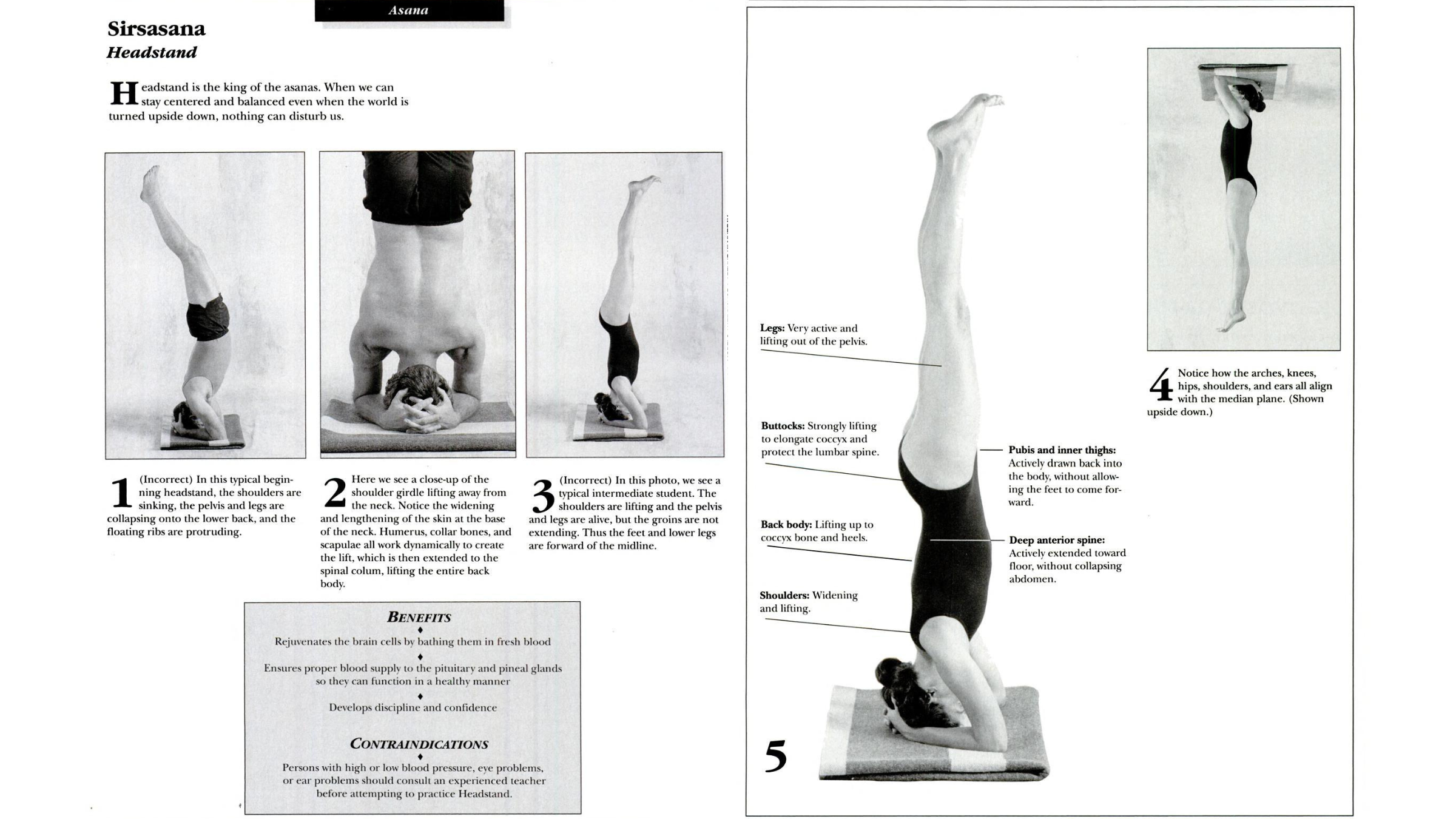
Students who can balance steadily in the center of the room can begin to explore the effect on the pose of the pelvic and brain diaphragms. Most beginning students look something like the “inverted banana” in Figure 1. Your shoulders sink, the floating ribs and upper lumbar hang forward, your back body collapses, and your legs fall behind the midline. With no vertical extension, the weight of the torso collapses onto your neck and skull, compressing the brain diaphragm. The legs are not lifting, and their weight hardens the posterior pelvic floor and the inner front groins. The anterior coccyx bone hangs unsupported.
Instead, your arms and shoulders must lift actively away from the neck and skull. Figure 2 shows a close-up of the correct lifting action. Note the widening of the upper inner shoulder blades and the lifting of the inner and outer deltoid muscles, which lifts the weight of the torso away from the neck and skull. This action can be learned in Downward-Facing Dog (Adho Mukha Svanasana).
Your legs also must be brought forward, lifting the lumbar, pelvis, and legs to eliminate the banana-like collapse. Intermediate students often learn this action, only to close the anterior pelvis and inner groins and lose the support of the posterior coccyx (see Figure 3). The front and inner groins must be dynamically extended, without collapsing onto the lumbar. Your legs must work tremendously in Headstand to open the pelvic diaphragm. In working the legs, be sure to extend the bones from the pelvis without hardening and tensing the muscles—rather, keep the muscles vibrant. If the leg muscles harden, the pelvic diaphragm will tighten and the brain will become pressurized and confused.
In the completed position (Figure 5), your front body and back body extend evenly, aligning the bones with gravity. When the bones are aligned, they can support the weight of the body without muscular strain. Figure 4 has been inverted to show the alignment of the arches, knees, hips, shoulders, and ears. By lifting evenly out of the pelvis, the bones of the legs free the pelvic diaphragm to breathe and pump blood to the legs. The dynamic action of the legs lifts the weight of the torso from the skull, allowing the brain diaphragm to breathe.
The anterior and posterior sides of the coccyx bone are supported, freeing the pelvic diaphragm. This freedom allows the respiratory diaphragm to breathe easily, which in turn allows the brain to feel relaxed and spacious. Thus the whole pose feels spacious, stable, and comfortable.
Stability and comfort are prerequisites for deeper work in the poses. As Vyassa says in his commentary to the first of the Yoga Sutras, yoga is samadhi. Sthira and sukham are the beginning of the samadhi state and thus are the point at which true yoga commences. All previous action is preparatory in nature. To achieve thira and sukham, it is not sufficient just to sit in any comfortable pose. Rather, you must perfect the pose to such an extent that samadhi can spontaneously awaken.
The universe is alive, awakening and creating itself anew with each moment. If we create the proper foundations of shira and sukham, so that our mind and body are clear and calm, we can directly experience this awakening and creativity. With 10 years until the turn of the millenium, human consciousness is awakening to its own inner potentials as it is simultaneously awakening to the potentials of the natural world. All serious practitioners of yoga should work to be stabilized at least in the beginning level of thira and sukham by then, so we can usher in a new age of planetary awakening, with wisdom, compassion, and ecological communion with the natural world as our goals.
