

That “freshly cleaned” smell may hide a surprisings
Date:
September 26, 2026ented cleaners can react with ozone indoors to create billions or trillions of invisible nanoparticles that can penetrate deep into the lungs. The pollution forms within minutes and, in some cases, may produce an inhaled particle dose comparable to or greater than standing near heavy traffic.
Share:
FULL STORY
A room that smells like citrus, pine, or flowers is often associated with cleanliness. Those familiar scents, however, can signal chemical reactions taking place in the air.
Research led by Brandon Boor at Purdue University found that fragrance compounds released by both conventional cleaners and botanical essential oil-based products can rapidly react indoors and generate nanoparticles. If inhaled, some of these extremely small particles can penetrate deep into the lungs.
The researchers say exposure can be reduced
The researchers say exposure can be reduced by choosing unscented products, improving ventilation with exhaust fans or open windows, and avoiding devices that generate ozone while scented cleaning products are being used.
The researchers presented their results at the fall meeting of the American Chemical Society (ACS) during the “Healthy Indoor Spaces: Bridging the Microbiome and Chemistry” symposium in McCormick Place.
“Importantly, cleaning removes viruses and bacteria from surfaces, but it can also generate invisible air pollution. There’s no visible dust or smoke in the air, but these particles are forming.” — Brandon Boor
Cleaning Can Create Invisible Nanoparticles
“We showed that indoor ozone reactions with fragrances from cleaning produce nanoparticles that carry a respiratory dose comparable to, or greater than, what you would experience from standing outside along a busy road,” says Boor, an Assistant Professor of Civil and Construction Engineering at Purdue University who studies indoor air quality. “The particles are different in terms of their composition, but the total dose can be higher. You’re not seeing smoke, dust, or haze in the air. Instead, you think the air smells great so it must be clean.”
Boor began investigating how cleaning agents and chemical
Boor began investigating how cleaning agents and chemical disinfectants affect indoor environments during the COVID-19 pandemic with his colleague Nusrat Jung, a Purdue Assistant Professor of Civil and Construction Engineering. One feature quickly stood out: many of the products people use to clean and disinfect indoor spaces contain strong fragrances.
“That’s often to create a pleasant smellscape in the indoor space,” says Boor. “But clean air should not smell like highly concentrated citrus fruit. It should not really smell of anything.”
Scientists who study the atmosphere have long known that compounds released by plants can react with ozone. Terpenes such as pinene from pine trees, for example, can participate in reactions that generate tiny airborne particles. Over time, those particles can combine and grow until they become large enough to help seed clouds.
That chemistry proceeds relatively slowly in forests because
That chemistry proceeds relatively slowly in forests because the amount of terpenes in outdoor air is generally low.
Cleaning Products Release High Levels of Terpenes
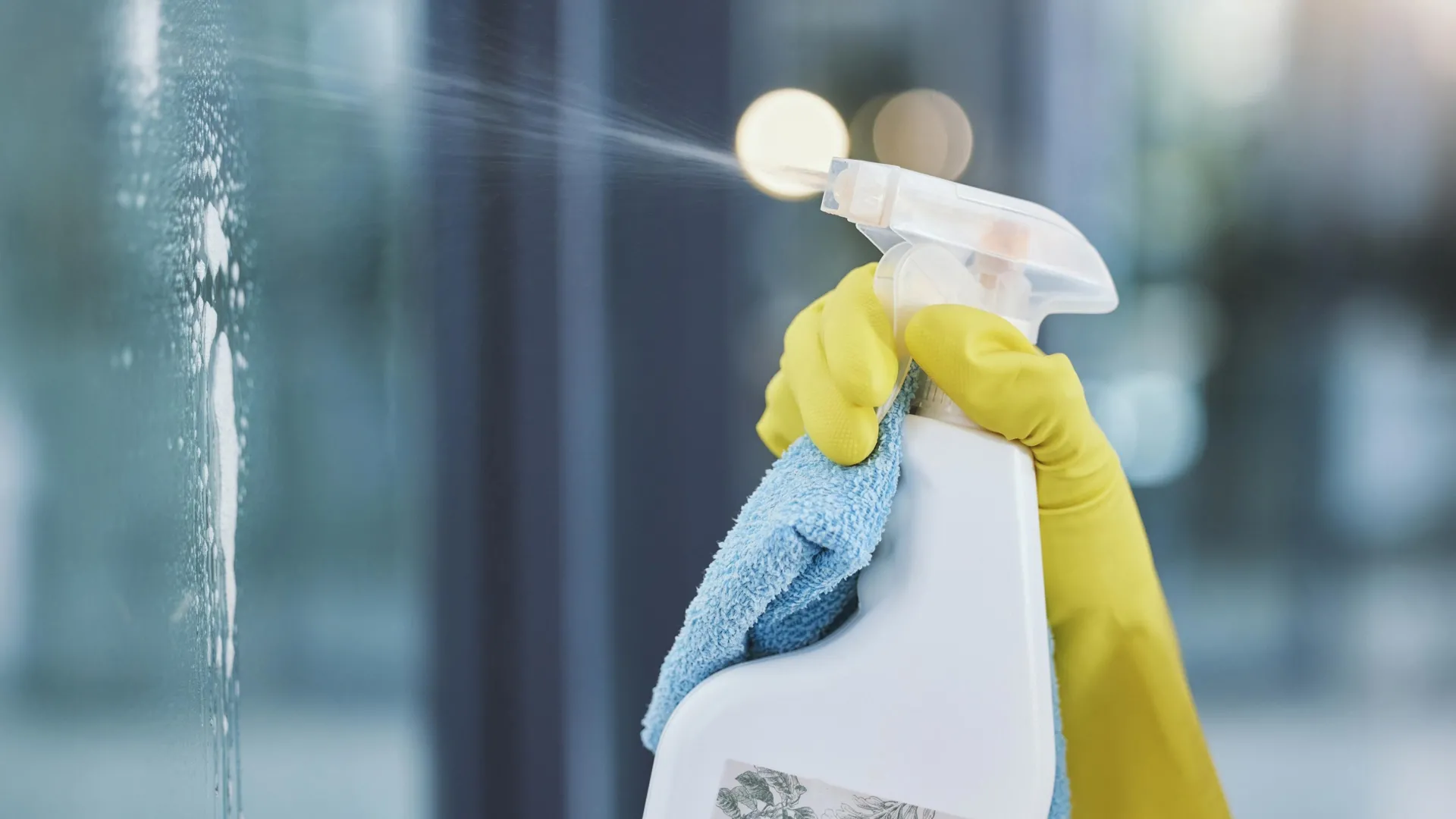
Indoors, the situation can be very different. Scented cleaners release terpenes when fragrance compounds evaporate from sprayed droplets or cleaned surfaces.
Cleaning liquids commonly contain compounds including pinene, limonene (lemon), thymol (thyme), and linalool (lavender). Their concentrations during cleaning can be far higher than levels typically measured outdoors. Boor says airborne terpene concentrations inside a room during cleaning can rise to tens or even hundreds of times those found in a forest.
To examine what happens under realistic conditions,
To examine what happens under realistic conditions, the researchers tested scented conventional liquid products as well as botanical-containing disinfectant sprays and wipes inside a model home on Purdue’s campus.
The small house includes a functional kitchen, wood flooring, and a bathroom, allowing the researchers to recreate ordinary household cleaning activities. Their experiments showed that the same basic chemistry responsible for nanoparticle formation outdoors can occur indoors much more rapidly and at much higher concentrations, with potentially important consequences for human exposure.
Billions or Trillions of Particles Can Form
Routine tasks such as mopping floors, spraying countertops, and wiping surfaces with scented products generate billions or trillions of particles, with the total depending on the product.
Most were nanoparticles or ultrafine particles measuring only
Most were nanoparticles or ultrafine particles measuring only 1-30 nanometers across. Because particles this small often fall outside the detection range of at-home air quality monitors, people may have no indication that particle concentrations have risen.
The researchers found that ordinary cleaning can temporarily push ultrafine particle levels above those measured outdoors.
Their tiny size is important from a health perspective. Ultrafine particles can settle throughout the respiratory tract and reach deep regions of the lungs. Once there, they can contribute to irritation and inflammation in the respiratory system. Some may also have the potential to enter the bloodstream.
One of the biggest surprises was the speed
One of the biggest surprises was the speed of the process. Particle formation and growth occurred within just minutes.
“By the time you finish cleaning up an indoor space, you’ve already formed a lot of nanoparticles and inhaled them,” says Boor.
Ozone Can Intensify Indoor Particle Formation
More recently, Boor and Ernest Blatchley, a Professor at Purdue, studied what happens when scented surface cleaners are used at the same time as germicidal far-UV (UV-C) lamps designed to disinfect indoor air.
The combination created particularly favorable conditions for nanoparticle formation.
The lamps interact with oxygen in the air
The lamps interact with oxygen in the air and produce ozone. During experiments in the tiny home, ozone concentrations increased to roughly 20 to 40 parts per billion. Those levels were comparable to, although somewhat below, the outdoor ozone concentrations measured when the experiments were performed.
With both elevated ozone and high concentrations of terpenes present, nanoparticle production became even more intense. That combination raised additional concerns about the amount of particulate matter occupants could inhale.
How to Reduce Exposure While Cleaning
Boor emphasizes that the goal is to help consumers make informed choices rather than discourage cleaning. Cleaning remains important for removing viruses and bacteria from surfaces, but several simple measures may reduce exposure to the secondary pollution produced during the process.
- Choose low-fragrance or fragrance-free products.
- Avoid applying several scented products in the same cleaning session.
- Run exhaust fans or open windows to ventilate the space.
- Do not simultaneously clean surfaces with scented products while using ozone-generating devices, such as far UV-C lamps.
Importantly, cleaning removes viruses and bacteria from surfaces,
“Importantly, cleaning removes viruses and bacteria from surfaces, but it can also generate invisible air pollution,” says Boor. “There’s no visible dust or smoke in the air, but these particles are forming.”
Boor thanks all the graduate students who have worked with him in the tiny house experiments along with the support of undergraduate students.
The research was funded by a National Science Foundation Faculty Early Career Development Program (CAREER) grant and the Alfred P. Sloan Foundation.
Title Indoor atmospheric nanoparticle formation from scented cleaning products
Abstract Scented volatile chemical products, including surface cleaning
Abstract Scented volatile chemical products, including surface cleaning agents and botanical disinfectants, are widely used indoors and represent a major source of reactive organic emissions. These products are routinely applied in homes and workplaces for surface cleaning and disinfection to reduce the presence of viruses and bacteria. However, their role in driving indoor atmospheric chemistry and nanoparticle formation remains poorly constrained. This presentation investigates the impact of scented cleaning product use on airborne nanoparticle nucleation, growth, and human exposure to secondary pollutants in indoor environments. Field and laboratory experiments were conducted in controlled residential and office settings using real-time, high-resolution measurements of volatile organic compounds and nanoparticle size distributions extending to the nanocluster aerosol (1-3 nm) regime. Surface cleaning and disinfection activities produced rapid increases in terpene and terpenoid mixing ratios (10-1,000 ppb), often exceeding levels observed in outdoor forested environments. These compounds reacted with indoor oxidants, particularly ozone, to initiate intense nanoparticle nucleation and growth events. Observed nucleation rates (~105 cm-3 s-1) and condensational growth rates (up to 300 nm h-1) exceeded typical outdoor values by orders of magnitude, resulting in transient indoor nanoparticle number concentrations of 105-108 cm-3. Rapid nanoparticle growth enabled survival to sizes that efficiently deposit throughout the human respiratory system, yielding inhalation dose rates comparable to or exceeding those from primary combustion sources such as traffic emissions. Both conventional and botanical cleaning products generated complex multiphase exposure scenarios involving reactive gases and secondary organic aerosol. These findings identify indoor surface cleaning and disinfection as key drivers of indoor atmospheric nanoparticle formation and highlight the need for improved building ventilation, air cleaning, and product formulation to mitigate exposure to secondary pollutants.
Materials provided by American Chemical Society. Note: Content may be edited for style and length.
American Chemical Society. “That fresh cleaning smell could be filling your home with nanoparticles.” ScienceDaily. ScienceDaily, 26 September 2026. <www.sciencedaily.com/releases/2026/09/260925093152.htm>.
American Chemical Society. (2026, September 26). That fresh cleaning smell could be filling your home with nanoparticles. ScienceDaily. Retrieved September 26, 2026 from www.sciencedaily.com/releases/2026/09/260925093152.htm
American Chemical Society. “That fresh cleaning smell could be filling your home with nanoparticles.” ScienceDaily. www.sciencedaily.com/releases/2026/09/260925093152.htm (accessed September 26, 2026).
RELATED STORIES
