

Published November 15, 2026 04:02AM
In Yoga Journal’s Archives series, we share a curated collection of articles originally published in past issues beginning in 1975. This article about overcoming obstacles in lifefirst appeared in the May-June 2003 issue of Yoga Journal. You can find more of our Archives here.
As we practice asanas (yoga postures) with awareness, we not only feel better, we are also better able to feel. That is, we become more sensitive to everything in our lives. As our sensitivity deepens and widens, we begin to practice asanas in such a way that we are practicing the larger yoga, which is the discovery of our Self and our dharma (our true purpose) and the overcoming of the obstacles that impede this journey.
In the Yoga Sutra, Patanjali explains the five main kleshas (obstacles) on the yogic path. They are avidya(ignorance); asmita, (ego); raga (attachment to pleasure); dvesha (aversion to pain); and abhinivesha(the fear of death). Though there are many yogic methods for dealing with the kleshas, asana practice—both the poses we explore and the manner in which we work in them—can be one of the most powerful of yoga’s tools for helping us overcome these afflictions.
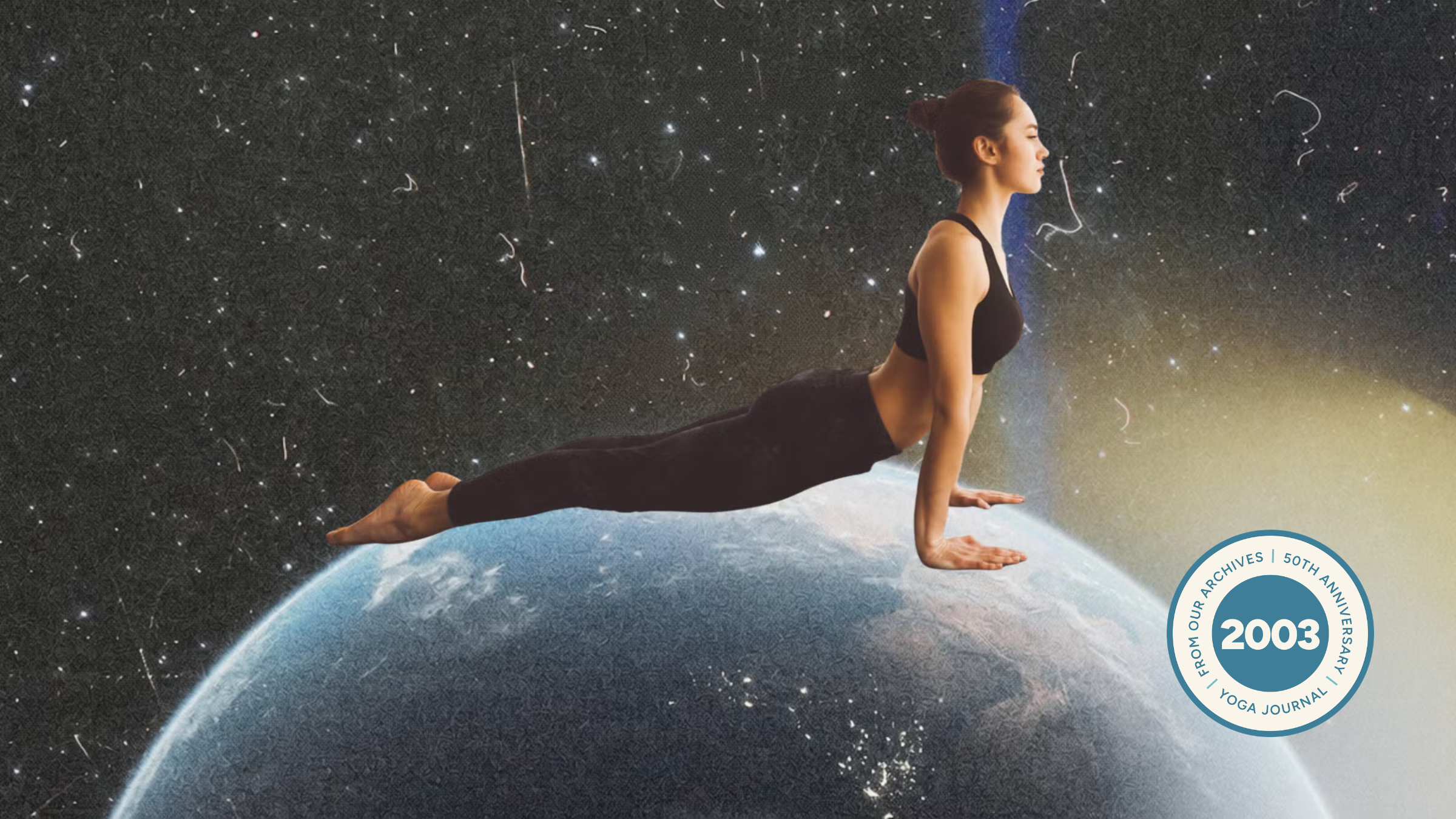
For all these obstacles, hatha yoga has a powerful remedy: backbends. Let us then take a look at the ways in which backbends—and specifically one of the most common backbends, Urdhva Mukha Svanasana (Upward-Facing Dog Pose)—can help us face the kleshas and overcome them.
Overcoming Obstacles in Life With the Kleshas
How can we work on the kleshas while practicing backbends?
1. Ignorance (Avidya)
In the epic poem Savitri, the Indian sage Sri Aurobindo writes, “Where ignorance is, there suffering too must come.” Patanjali says that avidya, or ignorance, is the father of all the kleshas, so let us begin there.
Because backbends demand such focus, they are extremely powerful tools for overcoming ignorance. In an asana, any part of the body in which awareness is not present when it should be can be called ignorant. And any ignorant part of the body prevents the free flow of energy, causing stagnation. So our work is to bring awareness to the parts that are ignorant, replacing avidya (ignorance) with vidya (knowledge).
Among the asanas, backbends are especially useful in this process, since they require strong concentration and open the chest and heart center. There are many manifestations of bodily ignorance that show up regularly in prone backbending poses. The most common mistake is to do these poses with the shoulder blades up near the ears. Another common site of ignorance, especially in Urdhva Mukha Svanasana, is the neck. If you are not aware of your neck while doing this pose, you compress your cervical vertebrae and demonstrate once again that “where ignorance is, there suffering too must come.”
Avidya in our physical body also manifests in the mind, which becomes unable to pay attention or retain and recall information. If we are to dispel our ignorance, we must cultivate the ability to focus our attention as well as the ability to calm our minds. Indeed, an unfocused brain cannot be calm. Thus, the ability to focus is a precursor to learning how to make the brain quiet.
2. Taming the Ego (Asmita)
As we practice and discover the ignorant parts of our body, our more refined awareness lets us see that these parts are being sacrificed to fulfill the ego. The ego’s desire to gratify itself makes us oblivious to restraint. We plow into poses just so that we can appear to be doing the posture. When we abuse the lumbar spine in Urdhva Mukha Svanasana to get a deeper-looking backbend, rather than slowly strengthening the lift of the pit of the abdomen, that too is ego.
The ego doesn’t care about balance or integrity, because it is more concerned with performance and getting as far as possible as fast as possible. The ego is competitive, yet it feeds itself both on achievement and on self-pity. Whether the ego says, “I am the greatest” or “I am the weakest,” it is all the same: It is all about the “I.”
Backbends also help us overcome the obstacle of asmita, the ego, because they open the heart center, the seat of our connection with our higher Self. Asmita is the mistaken identification of the small, individual self with the universal, supreme Self. The ego believes it knows everything and thinks that the universe revolves around it. As the ego grows, consciousness moves away from the heart and into the brain. Over time, the connection between the mind and the heart—the smaller self and the larger Self—is lost. Backbends help bring us back to this connection.
The ego also blocks our progress in asana, for it assumes we have knowledge where we are ignorant. When we puff out the chest to appear powerful, denying the very weakness in our core, that is ego. The ego makes us believe that we have achieved a certain level of practice when actually we haven’t. It encourages us to practice for self-glory and pride rather than for the discovery of the spirit-self.
To work on the ego is to face the shadow self. The shadow self is that part of us which does not want to go to the light. It is the part we hide so that we can appear to be good. We do not want to face it, because it runs contrary to our self-image and is out-of-sync with our conscience. Yet unless we are willing to uncover and work on our shadow in both our asanas and our lives, unless we are observing our ego’s urge to repress our darker parts, we are not truly progressing on our path.
Backbends not only help us uncover the shadow but also create space for the heart chakra to open. As this happens, we release our egoistic viewpoints and see the basis of others’ thoughts, even when they are opposed to our own. Isn’t this the foundation for creating world peace, one yogi at a time?
3. Transcending Attachment
In asana practice, as elsewhere in life, we are attached to pleasure (raga) and averse to pain (dvesha). But the true practitioner of yoga understands that temporary discomfort often leads to more stable and permanent pleasure. In fact, our aversion and attachment often stem from confusion. Looking only at the immediate effects of actions, we mistakenly label as pleasurable that which feels good in the moment even if, in truth, its real long-term effect will be painful.
In the practice of Urdhva Mukha Svanasana, for example, relaxing the shoulders and arms may momentarily feel pleasurable, but this attachment to pleasure will, in the long run, cause tension and compression in the neck and collapsing in the chest. On the other hand, pushing down strongly with the arms, contracting the triceps, and using the side chest muscles can initially be painful—it certainly requires strong effort—yet these actions lead to freedom in the neck and expansion in the chest.
Be conscious throughout your practice of Urdhva Mukha Svanasana—indeed, in all backbends—that you do not just fold the spine at a single point or area. Much as folding a paper clip many times at one point eventually breaks the metal, such acute folding of your spine can create compression and damage. The lower back and the neck are especially susceptible to such collapse.
4. Arching Over Obstacles
The chest and heart openings provided by backbends also counteract the last three of the five kleshas: raga, dvesha, and abhinivesha. Raga, our attachment to pleasure, is a futile grasping of the ephemeral—we clutch what is only transient. In doing so we close our chest and shut down the heart center. Dvesha, aversion to pain, also closes the door to our hearts. When we cover up pain, we cover up our shadows, the parts of ourselves that we repress because they do not please the ego. As with raga, our aversion is not expressed with open, wide arms but with a clutching, defensive posture.
5. Approaching Each Pose As If for the First Time
Abhinivesha, the fear of death, is the father of all fear, the primal cause for all shrinking of the chest, hunching of the spine, and withdrawing back into our small selves.
As we practice Urdhva Mukha Svanasana, how can we work on the final klesha, abhinivesha, the fear of death? By approaching and practicing the pose as though it were new to us every time we come into it. The fear of death is the fear of change; only as we accept change can we turn this fear away and grow. Doing the pose today as we did it yesterday is reenacting a dead pose. Doing the pose according to the inspirations of today gives birth to a pose that is alive.
Yet new life doesn’t exist without the old life dying; we must let go of yesterday’s accomplishments in order to keep growing. Each time we practice asanas in a new way, we work on overcoming our personal fears of death and rebirth, taking another step into a truer and more luminous life.
